Tuesday, October 27, 2015

SHOCK 'GENOCIDE' & 'APARTHEID' IN MALAYSIA'S SCHOOLING SYSTEM Written by Asia Sentinel

SHOCK 'GENOCIDE' & 'APARTHEID' IN MALAYSIA'S SCHOOLING SYSTEM
Tuesday, 27 October 2015 14:32 
On Oct. 12, seven children – six girls and a boy between the ages of seven and 11 – were discovered to have died in Malaysia’s northeastern state of Kelantan after being lost for 48 days in the jungle, having run away from their residential school. Two girls survived by eating grass and wild fruits.
The children were Orang Asli, loosely translated as forest people, the indigenous peoples who were the original inhabitants of the Malay Peninsula before ethnic Malays arrived, mostly from Indonesia. They had run away to escape harsh punishment for bathing in a nearby river in Pos Tohoi in the Gua Musang District. Despite supposedly honoring the Orang Asli as bumiputeras or sons of the soil, in fact the Malaysia government does not treat its indigenous peoples well, instead seeking to force-assimilate them into the Malay-Muslim culture.
The plight of the East Malaysian Penan tribe of Sarawak is another case study of marginalization and cultural genocide that is well-known internationally, with stories of the peoples of the forest defending their right to exist in face of the government’s building of mega-projects.
The horrific story of the death of the Gua Musang children is an example of how education in Malaysia has turned genocidal. It also points to the idea of what state schooling means to the indigenous people and how, in the case of the children of the ethnic Temiar tribe who perished, what form of mental torture is inflicted upon them in a state identified as “most Islamic” in the country. Kelantan is unofficially named “The Verandah of Mecca.” (Serambi Mekah) by the leaders of the ruling state government, Parti Islam se-Malaysia, or PAS.
How is this so, and what does it say about the state of educational evolution and crisis of cultural degeneration Malaysia is in? For the world to understand how this modern society has evolved and how its people are schooled for social reproduction, one must understand the types of schools that have come into being

Seven types of schools In Malaysia
Since independence, and as a legacy of British colonialism of divide and conquer as well as following the mold of Americanism, Malaysia has developed seven types of schools namely,
1) POWER SCHOOLS, i.e. international schools meant for the rich and powerful who will compete and collaborate with children of expatriates and to save children from the children of the poor and of the natives;
2) PRIVATE SCHOOLS, i.e. most often very expensive ‘breakaway schools’ meant to save children from poor teaching, overcrowded classrooms, and to save children of the rich from those of the lower and middle class;
3) PRIVILEGED SCHOOLS, i.e. well-funded boarding schools built to safeguard racial privilege and to instill ketuanan Melayu (the self-proclaimed sense of superiority of the Malays) amongst children who did well in their kampong schools to be saved from the schools for the poor, to groom them so that they will become leaders that will protect the rights of this or that race;
4) PAROCHIAL SCHOOLS, i.e. schools that sustain the transmission of this or that culture based on the perceived superiority of this or that language, culture, and religion, so that the children will be saved from being washed away by the tide of cultural change brought by the children of the poor;
5) PUBLIC SCHOOLS, i.e. government schools that sustain the ideology of the ruling regime par excellence and en mass, deploy curriculum that passes down ‘Official Knowledge and Grand Narratives of One Particular Historical, Cultural, Scientific truths’, train the children of the poor to be nationalistic and patriotic unquestionably, and those used as a training ground for children to participate in nation-building as servants and appendages to the state capitalist system so that the children will grow up as defenders of the evolving totalitarian state;
6) ‘PROOF-OF-CONCEPT’ SCHOOLS, i.e. well-funded ‘pulled-out’ government schools to prove that public schools do work as a showcase of innovations and good management, authentic assessment and evaluation, as a way to show that selected schools can be saved from the failing public schools, and that a failing policy can be saved by a successful showcase of ‘smart ways to schooling’;
7) PARIAH SCHOOLS, i.e. schools that beg for money from the government even to fix the roof or a toilet … fit for a punishment haven for children simply because they are born out of the wrong race, class, or caste, and schools for those whose parents did not go to any of the schools above.
What then must Malaysians do in this apartheid scheme of schooling and mass-babysitting? How can they stop this educational conveyor belt from moving, to give each child the right to be intelligent in a level playing field? Dare they vote in a government that would correct the imbalances of a class system of social reproduction?
Malaysians have successfully created classes of society through the classification system of schools and through the class ideology we directly or indirectly teach in our classrooms. There are schools for the rich and schools for the poor. Like labeling cage-produced chicken eggs, they assign “grades” to their schools.
When schools are failing, they try to create independent schools and profit from more private schools, leaving behind the children of the poor of all races to be recycled in the system of structural mental-ideological violence. They are wasting talent. Instead of making the government slogan “brain gain” a reality, we are making brains go down the drain.
They have also created a dispossessed youth with passion for death-defying drag-racing, the so-called Mat and Minah Rempits, or street racers as well as essentially loan-shark alongs preying on the financially desperate, and gangsters groomed in the rubber estates and depressed urban areas.
These are the products of unthinking schooling and reproductions of the post-industrial society. The society has neglected the development of their children’s minds and has created successful failures through the schools they build. The government has appointed educational leaders who perhaps have never set foot in a classroom, let alone in those of the most impoverished areas of our country.
What is our problem with the enterprise called ‘Education’? What then must Malaysians do? It seems that they are only reading daily about the mega-fiasco of the 1MDB and the fruitless war between the camps of the former leader Mahathir Mohamad and the current one headed by Najib Razak about who is stealing how much of the people’s money, now and forever.
Essentially Malaysians continue to neglect the debate concerning their children’s future – their great school debate. 

http://www.asiasentinel.com/

Monday, October 19, 2015

Shape of a Pocket

Siapa Melayu?

IF it is true that Malay-rights group Perkasa was able to sabotage the government’s New Economic Model, hence obstructing much-needed reforms for the nation, what is this telling us?
Perkasa logo
Perkasa logo
It tells us that if the Barisan Nasional (BN) government is so easily held ransom by right-wing race-based groups, it is not fit to govern multiracial Malaysia. It also tells us something else about the BN government that further proves just how unqualified it is to run this country. If the BN is so easily swayed by the clamouring of “Malay rights”, often projected writ large as “ketuanan Melayu”, it is telling the rakyat this: that despite our independence from the British after more than 50 years, the current government still subscribes to and upholds the colonial construct of race and racial superiority.
Indeed, this fixation with race, especially the Malay race and its attending “rights”, as groups like Perkasa and parties like Umno would have it, is not just colonial. It’s also completely arbitrary and bewildering. Worse, it is this fixation that makes it so easy to deny equal opportunities for all citizens. And in worst-case scenarios, it makes it easy for racism to take root.
Now you’re Malay, now you’re not
Here is evidence of how arbitrary race is. Did you know that, depending on whether one is in Perlis or Pahang, one can either qualify or not for Malay reserve land because of the states’ different definitions of what constitutes a Malay?
Constitutional law expert Prof Emeritus Datuk Dr Shad Saleem Faruqi explains this in an e-mail interview. He says while all state constitutions have adopted the Federal Constitution’s definition of “Malay”, for purposes of Malay reserve land, all West Malaysian states have their own definitions as to the origins of a Malay.
So, apart from being a Muslim in all these states, in Kedah and Perlis, persons of “Malayan race or Arab descent may qualify as Malays”. In Johor, it is sufficient to be of a “Malaysian race” to be Malay. In the Federal Territories, Negeri Sembilan, Pahang, Perak, Selangor, Kelantan and Terrengganu, a Malay must belong to a “Malayan race”.
There are also other differences according to state with regard to language, custom and birth, and descent. Shad, who is also Mara University of Technology legal adviser, observes: “As one moves through the states in West Malaysia, one is Malay, then not Malay, then Malay again under these state enactments.”
And what exactly is a Malaysian or Malayan race? Do they include all the races in Malaysia, and/or previously in Malaya?
Shad notes that only the state constitutions of Malacca and Penang define “Malay” in line with the Federal Constitution’s definition. In these states, there are no requirements related to “ethnic origin” before one can qualify for Malay reserve land.
Constructing a Malay
Shad Saleem
Shad Saleem
However, even the Federal Constitution’s definition of “Malay” is “quite eclectic in that it allows someone to move in and out of being ‘Malay’,” Shad says. How so?
According to Article 160(2) of the Federal Constitution, a person is “Malay” if she or he satisfies the following four requirements:
 must be Muslim;
 speaks the Malay language habitually;
 follows Malay adat; and,
 was born in Malaya or in Singapore before Merdeka Day, or is descended from at least one parent who was born in Malaya or in Singapore before Merdeka Day.
“In the Federal definition, there is no requirement that one must be of Malay stock. Non-Malays who satisfy the four requirements will be deemed to be Malays. A convert to Islam may qualify as a Malay.
“Conversely, ethnic Malays who fail any one of the four requirements, for example, Malays from South Africa, Sri Lanka, Thailand, the Philippines and Indonesia – may not qualify as Malays under the Federal definition,” Shad explains.
By this definition, even a Malay Malaysian who leaves the faith, or who stops speaking Malay or no longer practises Malay adat, will cease to be “Malay”.
This then begs the question: Who exactly is “Malay” in the context of Malaysian political life? And if privileges and “special rights” are going to be assigned to the “Malay” and denied the other races, shouldn’t “Malay” or “non-Malay” be something that is less arbitrary?
“My son is now Chinese”
Christopher De Shield, a Creole from Belize, tells a story that underscores how subjective the notion of race is, and the confusion it causes even within the National Registration Department (NRD).
De Shield is married to a Chinese Malaysian, and when he tried to register their son’s birth in December 2010, the NRD officer wanted to categorise their son as “Dan Lain-Lain: Belizean”. De Shield then pointed out that “Belizean” was a nationality, not a race. He himself is of mixed ancestry, as are other Creoles from the Caribbean. Because the officer was stumped, De Shield then suggested that his son be categorised as “Chinese” since his wife was Chinese. “My son is now Chinese,” De Shield chuckles, adding that he can’t wait to tell his family and friends about this amusing turn of events.
There are other anecdotes. My family is Eurasian, and yet my sister’s MyKad erroneously states that she is Punjabi even though we are from Penang, not Punjab. Another Eurasian friend from Penang tells us through Facebook that her sister was mysteriously classified as Kadazan.
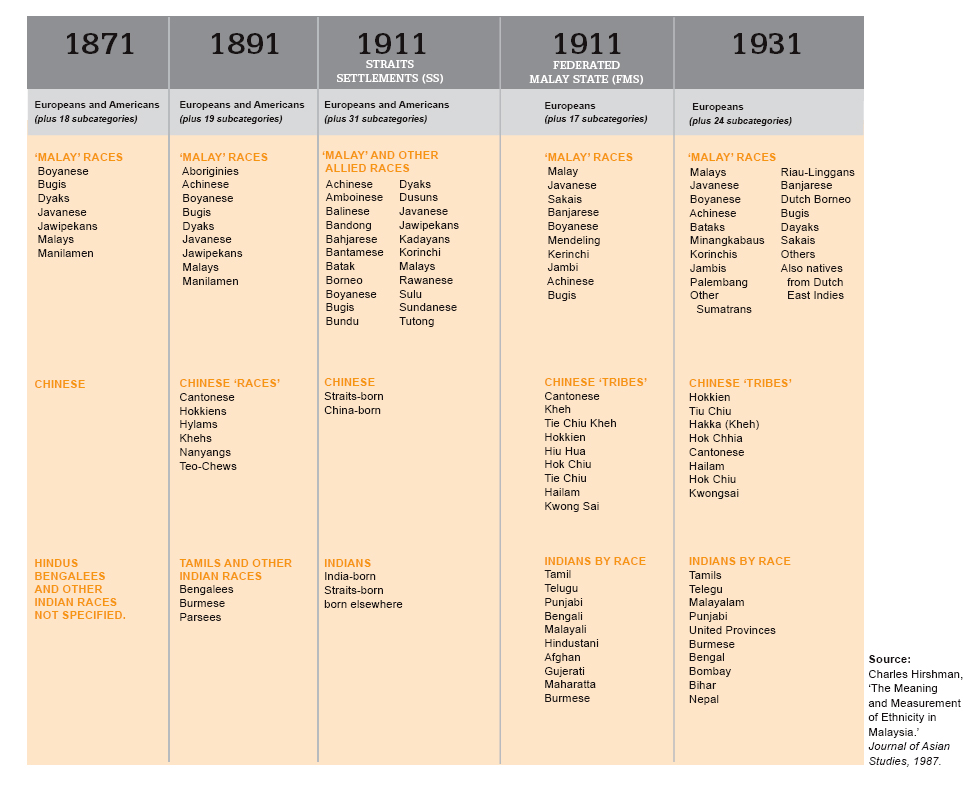
The truth is, race as we know it is arbitrary and constructed. Just look at this table which shows how the British kept changing the definition for Malays, Chinese and Indians:
The Meaning and Measurement of Ethnicity in Malaysia, by Charles Hirshman. Graphic courtesy of Matahari Books (Click for bigger view)
A false science
It bears remembering that race was a white and western concept that emerged through the development of European imperialism and social Darwinism, and which was used to justifyplantation slavery. Race was about how non-whites had different physical attributes from whites, which were then deemed to make them inferior to their colonisers.
It should come as no surprise then that this was exactly the kind of social-political structure that the British imposed on us. Indeed, it was the British who defined Malays as Muslims, and who made “Malay” an exclusive term with strictly defined boundaries.
So, if race is so arbitrary and was used to subjugate those who look different from whites, why are we still using race as a way to categorise Malaysian citizens? Why is the BN still using race-based policies to govern us? And why is it allowing “Malay rights” and “ketuanan Melayu” to prevent it from embarking on reforms and offering equal opportunities to all citizens?
Because race was the white coloniser’s subjective construct, one can perhaps understand why there is confusion even among NRD officers about the racial identity of Malaysians. And according to Shad, in Johor, Kwong Yik Bank, Maybank and Oriental Bank, as corporate bodies, qualify for Malay reserve land because they fall under the state’s definition of Malay. Go figure.
Who benefits?
Any of the Found in Malaysia interviews with Malay Malaysian personalities demonstrate how there is no such thing as a pure or exclusive “Malay” race.
Mahathir
Mahathir
And so, when former premier Tun Dr Mahathir Mohamad declares that non-Malay Malaysians must accept that Malaysia belongs to the Malays, one wonders who is the “Malay” he is referring to. Or when Perkasa and Umno leaders holler about “ketuanan Melayu”, aren’t they really propping up a colonial construct that was used to ensure systemic discrimination?
De Shield says he’s not concerned that his son is now officially registered as Chinese. De Shield, after all, is married to a Chinese Malaysian who bore their child. “But if I were a Malaysian citizen, I’d be worried about how the state uses these racial categorisations,” he says. Indeed, as Malaysians, we should. One wonders, though, if the BN is. 

Wednesday, October 14, 2015

2015 Malaysian Labor problems


Abuse, exploitation fail to stop blue-collar workers flocking to Singapore to cope with ringgit fall

BY JULIA YEOW, NEWS EDITOR

Singapore’s prosperity and strong dollar is a ‘pull’ factor for many Malaysians, who seek greener pastures in the island republic. – Reuters file pic, October 14, 2015.Singapore’s prosperity and strong dollar is a ‘pull’ factor for many Malaysians, who seek greener pastures in the island republic. – Reuters file pic, October 14, 2015.When 21-year-old Zuhalfizi Ismail from Negri Sembilan arrived to work in Singapore last month, he was confident his family’s mounting debts would be paid off within the year, and he would have saved enough to marry his childhood sweetheart.
But barely a month into his job as a cleaner with a large Singaporean firm, he now finds himself out on the streets, pockets empty, in one of the richest nations in the world.
“My boss cancelled my permit, and I have to go home. But when I asked for my salary, he said my contract says they can forfeit my salary because I worked less than three months,” Zulhafizi told The Malaysian Insider.
He is also one of hundreds of thousands of Malaysians in Singapore working blue-collar jobs that locals shun and, ironically, which migrant labourers in Malaysia are doing.
Zulhafizi, who was working as a general cleaner, said his job was terminated because he had repeatedly demanded to be paid for working overtime.
“They made me work 12-hour days for six days a week, but said I would only get S$500 (RM1,500) a month.
“They promised me S$1,200 before I came, but now they say I signed the contract agreeing to S$500.”
HOME executive director Jolovan Wham said Zulhafizi’s situation was similar to most of the foreign workers who come to the centre.
“Work contracts are signed in English which most of the foreigners have very little understanding of.
“Because his employers didn’t technically breach the contract, unfortunately, he doesn’t really have a case,” said Wham of Zulhafizi’s case, adding that HOME was now trying to work out an amicable settlement with his employers.
Seeking greener pastures 
Singapore’s thriving economy is a boon for immigrants from poorer neighbours and is now especially enticing for Malaysians with the continued decline in value of the ringgit, Asia’s worst performing currency.
Most of the semi-skilled or low-skilled workers are willing to accept lower wages than their Singaporean counterparts, and put up with less-than-satisfactory working conditions for the possibility of bringing home much higher wages than if they were to work in Malaysia.
Wham says apart from contractual disagreements, he has received complaints of physical intimidation by employers seeking to “discipline” their workers.
“One guy from Sarawak once complained that he was made to do push-ups.
“Another one was shoved and threatened with a punch,” Wham told The Malaysian Insider.
Every morning from Monday to Friday, Malaysian semi-skilled and skilled workers gather in Singapore’s Woodlands area with the hopes of being picked up for a day’s work, which will earn them up to S$80 (RM240). – The Malaysian Insider pic, October 14, 2015.Every morning from Monday to Friday, Malaysian semi-skilled and skilled workers gather in Singapore’s Woodlands area with the hopes of being picked up for a day’s work, which will earn them up to S$80 (RM240). – The Malaysian Insider pic, October 14, 2015.A total of 146 Malaysian blue-collar workers sought assistance from the Malaysian High Commission in Singapore from January to June this year, the high commission revealed. Total number of complaints for the whole of last year was 145.
High commission officials believe the figures are a fraction of the actual number of complaints, as many blue-collar workers find approaching non-governmental organisations, like HOME, for help to be less intimidating.
“Most of them have problems with their work permits, or their employers are not paying them or are keeping their passports,” a senior official at the high commission told The Malaysian Insider on condition of anonymity.
“We try to help by contacting their families in Malaysia, or by informing Singapore’s Ministry of Manpower. But honestly, there’s usually very little we can do,” he said, citing “diplomatic sensitivities”.
According to statistics provided by the Ministry of Manpower, the total number of work permits issued for semi- and low-skilled jobs in 2014 was 991,300. From January to June this year, 993,900 work permits for blue-collar jobs – including cleaners, constructions workers and factory workers – were issued.
The island-state recorded more than 1.35 million foreign workers last year, a figure that has already been surpassed as of June this year.
A 2012 World Bank report placed the number of Malaysians working in Singapore at more than 400,000, a figure that Malaysian officials believe has grown much higher in the past two years.
This means almost half of the tiny republic’s foreign labour force is made up of Malaysians, and the majority of them are in blue-collar jobs.
Risking arrest, fines and deportation
The attractiveness of earning in Singapore dollar, which was trading at S$1 to RM3.01 by the end of yesterday, has even emboldened Malaysians to risk hefty fines and arrest.
Every weekday morning at specific areas around Woodlands – Singapore’s northernmost suburb – hundreds of semi-skilled and skilled Malaysians with no legal permits will wait with the hopes of being picked up by employers looking for day-job workers.
Jobs ranging from painting to electrical and plumbing works pay from $50 to $80 a day, almost double of what they would get back home for the same amount of work.
The men wait at coffee shops, bus stations and other fixed spots around Woodlands from as early as 7am, waiting for owners of small cleaning or construction businesses to drive by and take their pick of workers.
At the end of the day, the workers get dropped back at the pick-up point, where they will make their way home with their day’s wages.
“Most days we don’t get any work, but sometimes if we’re lucky, an employer will ‘book’ us for a few weeks,” said Ah Lim, a Johor native who was one of the many Malaysians waiting on the steps of Woodlands Centre last Thursday morning hoping to be picked up.
Under Singapore’s Employment of Foreign Manpower Act, foreigners working without legal permits face a S$24,000 fine and up to 24 months’ jail.
Ah Lim, who works as a freelance electrician back in Johor Baru, said he was aware that he could be jailed and fined if caught, but says it was a risk he and his friends were willing to take.
“There’s very little work (in Johor Baru), so it’s better to take the risk and come here every day. By noon, if nobody comes, then I will return home,” he said.
“But I will come and try my luck again the next morning.”
Malaysians doing jobs foreigners at home do
Wham says while Malaysians make up a small percentage of the migrant workers coming to his organisation, he has already seen an increase in the numbers.
“The Malaysians who come here are doing jobs that foreigners are doing back in Malaysia. They work in low-skilled jobs as cleaners, or work in the service sector,” Wham said, referring to Malaysia’s 2.1 million legal foreign workers, and almost as many illegal migrants, who are employed in industries, such as construction, manufacturing and the service sectors back home.
“So Malaysia is both a receiving and sending country (of blue-collar workers). It’s quite a unique situation,” he said.
For Zulhafizi, his short-lived and bitter experience with one employer has not been enough to deter him from trying to seek re-employment in Singapore.
“If I manage to save S$1,000, and send it back every month, that’s RM3,000! I can’t even earn half that amount in Malaysia, much less save that amount,” he said.
“Of course, this experience has left me with a bitter taste, but it’s worth risking it again. I can’t find the same opportunity in Malaysia. There, my family is ‘sesat’ (lost).”


The structural regression of Malaysian manufacturing

Authors: Jayant Menon and Thiam Hee Ng, ADB
Malaysia’s manufacturing sector is reversing to a state reminiscent of its post-colonial stage of development. Regrettably this situation was avoidable.
When the Federation of Malaya gained independence from Britain in 1957, economic conditions were ripe for rapid and sustained growth. Its primary export sector was showing immense potential for expansion. Primary commodities — particularly tin ore and natural rubber — accounted for a third of Malaysia’s GDP and over 75 per cent of exports by 1970, a legacy of its colonial past.
But manufactured exports accounted for less than 10 per cent, raising concerns that heavy reliance on a few commodities left Malaysia vulnerable to terms-of-trade shocks from swings in commodity prices. There was little economic diversification up to the 1980s, with already undersized manufacturing focused on little more than processing agricultural and mining output.
Several terms-of-trade shocks in the early 1980s — followed by global recession a few years later — did ultimately balloon fiscal and current account deficits, setting the stage for radical reform. A new National Development Policy was introduced in 1990, easing the affirmative action strictures of the pro-ethnic Malay New Economic Policy (NEP) and placing wealth creation ahead of wealth redistribution. The Promotion of Investment Act of 1986 extended generous incentives for private investors and relaxed regulations on foreign direct investment (FDI), allowing for full foreign ownership of export-oriented companies. Massive FDI inflows ensued.
These reforms opened Malaysia’s gates to the global production network and it succeeded in developing a vibrant and competitive electronics sector. Manufacturing grew sharply from about 12 per cent of GDP in 1970 to over 30 per cent by the mid-1990s. The share of electronics in manufactured exports soared from below 50 per cent in 1980 to peak at more than 70 per cent in 2000. But its share has fallen to below 50 per cent again in 2015.
While Malaysia had an early start in electronics, it could not build on this technological advantage. As wages started to rise, skills remained weak. After the Asian financial crisis (AFC) struck in 1997, FDI in Malaysia never recovered and domestic investment slumped as well. Since 2006, Malaysia has been a net exporter of capital, a process many suspect is driven more by capital flight than outward FDI.
Although a net labour importer, Malaysia remains a net skills exporter, with growing numbers of professionals migrating to Singapore and other welcoming industrialised countries. With these developments, Malaysia’s good fortunes have reversed in recent years, both in manufacturing and across the economy.
Like its early post-colonial phase, Malaysia is moving back to processing its agricultural and mineral resources. The only difference now is that the commodities themselves have changed. Rubber and tin have shifted to palm oil and petroleum. Petroleum refining and palm oil processing accounted for almost 19 and 12 per cent of manufacturing output in 2012, respectively — with both of these industries now bigger than electronics.
While developing countries are often encouraged to process agricultural or mineral outputs before exporting to increase their value, Malaysia appears a rare example of an upper-middle-income country — aspiring to high-income status — that is stunting or even reversing its previous successes in manufacturing.
This manufacturing retrenchment has been demonstrated by the overall contraction of this sector’s share of GDP, which fell gradually to 24 per cent in 2008 to remain roughly at that level ever since.
Why should we care about Malaysia’s manufacturing contraction? The main concern about petroleum refining and palm oil processing is that they are capital-intensive and generate few jobs. Despite their importance in overall output, just 14,400 workers are employed in petroleum refining, compared to the nearly 200,000 workers employed in electronics. Furthermore, agro- and petrol-processing industries generate relatively low-productive, low-skilled jobs and so wages are also low. The largest share of manufacturing workers are plant and machine operators who have an average annual salary of around US$4000 when per capita incomes average US$11,000.
Malaysia may be experiencing ‘premature deindustrialisation’, having transitioned to a service led economy before it has fully reaped the benefits of industrialisation. But unlike many other countries with similar experience, Malaysia’s case appears to be driven more by policy than technological disruption, trade or globalisation. There is growing recognition that many of the country’s problems — including the slump in private investment — are rooted in the distortions resulting from the design and implementation of the NEP and its subsequent incarnations. The government-linked corporations spawned to serve racial economic redistribution now crowd-out private investment in most sectors of the economy, including manufacturing.
If Malaysia is to realise its aspirations and enjoy living standards associated with high-income countries, it must arrest this structural regression and revive private investment in manufacturing. But regenerating manufacturing is unlikely without an overhaul of current policies. And while Malaysia may still reach the technical threshold of high-income status in a few years — assuming an economic crisis can be averted till then — this will still mean little to the welfare of workers in manufacturing if it continues its journey backwards.
Jayant Menon is Lead Economist at the Economic Research and Regional Cooperation Department, Asian Development Bank (ADB), and Adjunct Fellow at the Arndt-Corden Department of Economics, the Australian National University.
Thiam Hee Ng is Senior Economist at the Economic Research and Regional Cooperation Department, ADB.

Conclusion

As developed economies have substituted away from manufacturing towards services, so too have developing countries – to an even greater extent. Such sectoral change may be premature for economies that never fully industrialised in the first place. 

The conventional explanation for employment deindustrialisation is based on differential rates of technological progress (Lawrence and Edwards 2013). Typically, manufacturing experiences more rapid productivity growth than the rest of the economy.

As developing countries opened up to global trade, their manufacturing sectors were hit by a double whammy. Those without a strong comparative advantage in manufacturing became net importers of manufacturing, reversing a long process of import-substitution.

In addition, developing countries ‘imported’ deindustrialisation from the advanced countries, because they became exposed to the relative price trends produced in the advanced economies. 

The decline in the relative price of manufacturing in the advanced countries put a squeeze on manufacturing everywhere, including the countries that may not have experienced much technological progress. This account is consistent with the strong reduction in both employment and output shares in developing countries (especially those that do not specialise in manufactures).
In sum, while technological progress is no doubt a large part of the story behind employment deindustrialisation in the advanced countries, trade and globalisation likely played a comparatively bigger role in developing countries.     
Deindustrialisation has been long been a concern in rich nations, where it is associated with the loss of good jobs, rising inequality, and declining innovation capacity. For all these and many other reasons, it should be a much bigger problem for developing countries. 
Premature deindustrialisation has serious consequences, both economic and political.
On the economic front, it reduces the economic growth potential and the possibilities for convergence with income levels of the advanced economies. Formal manufacturing tends to be technologically the most dynamic sector, exhibiting unconditional convergence (Rodrik 2013). Deindustrialisation removes the main channel through which rapid growth has taken place in the past.
The political consequences of premature deindustrialisation are more subtle, but could be even more significant. Mass political parties have traditionally been a by-product of industrialisation. Politics looks very different when urban production is organised largely around informality, a diffuse set of small enterprises and petty services. Common interests among the non-elite are harder to define, political organisation faces greater obstacles, and personalistic or ethnic identities dominate over class solidarity. Elites do not face political actors that can claim to represent the non-elites and make binding commitments on their behalf. Moreover, elites may prefer – and have the ability – to divide and rule, pursuing populism and patronage politics, and playing one set of non-elites against another. Without the discipline and coordination that an organised labour force provides, the bargains between the elite and non-elite needed for democratic transitions and consolidation are less likely to take place. So premature deindustrialisation may make democratisation less likely and more fragile.

Monday, October 12, 2015

Tuesday, October 6, 2015

No ‘lazy Malays’ during Japanese occupation – M. Bakri Musa


The Japanese Occupation briefly interrupted British colonial rule. Japanese troops landed in Kota Baru in the early morning of December 8, 1941, and surrendered some 43 months later. That was only a blink in our history but to those who suffered through that terrible period, it was eternity. As brutal as it was, Malays as a culture and community survived.
There was one significant but not widely noted disruption and humiliation of Malay culture during that period. The Japanese, despite their reverence for their own Sun God Emperor, had little use or respect for Malay sultans. At least the British maintained the facade of respect even though those sultans were essentially colonial puppets.
The colonials saw in the institution of Malay sultans an effective means of indirect rule. The British knew full well the reverence Malays had for our sultans. The British must have learned a thing or two from observing kampong boys herding their kerbaus (water buffaloes). Pierce a ring through the lead buffalo’s nose and then even a toddler could effectively control the herd by pulling on the rope tied to that lead beast's ring.
That essentially was the British approach to controlling the Malay herd; pierce a ring through their sultan’s nose. The rope may be of silk and the ring of gold, but the underlying dynamics are the same.
The Japanese on the other hand totally ignored the sultans. They did not even bother going through a formal ceremony of “de-recognizing” the sultans. The surprise was not how quickly and easily the sultans ceded their power, rather how unceremoniously those sultans lost their honour and prestige among their own subjects.
I once saw a documentary shown in the village by the Information Department about the royal installation of the first Agong. He happened to be the Yang Di-Pertuan Besar of Negri Sembilan, my state. The next morning I overheard a group of Malay women chatting with my mother. They were making fun of the pompous ceremony depicted in that film.
Those villagers did not see a Queen as the rest of the country did. Instead they saw their former fishing mate made pretty and regal. They remembered her only as a woman wrapped in her wet tattered sarong arguing over a fishing spot in the river during the Occupation. Neither pretty nor regal! My mother remembered her as particularly inept with her tanggok (fishing net). If not for the generosity of fellow villagers, the future queen and her husband would have starved during the Occupation.
There was something else amazing about those shared fishing trips my mother and the other villagers had with the future queen, and that was the obvious absence of royal fuss or protocol. Only a few months before the Japanese invasion, those members of the royalty could with a click of their fingers command a villager to do their bidding. He would then have to stop whatever he was doing, stoop low, crawl towards the raja and express what a great honour it was to be a slave of the sultan! And if he were to inadvertently make eye contact with the sultan, may Allah have mercy on him for the sultan certainly would not.
All that royal pomp and ceremony together with other elaborate palace rituals vanished overnight under the Japanese. The remarkable thing was, and the villagers did not fail to notice this, how quickly those former royals adapted to their new plebeian status! They were not above bickering over a coconut or their favourite fishing hole.
The Japanese also had a profound effect on the behaviour of ordinary Malays, especially the youths. Once as a youngster a few years after the war, my father and I were strolling in the village when we encountered a bunch of unemployed Malay boys hanging around and making a nuisance of themselves. Behind them was an abandoned field covered with overgrown brush.
My father commented that such a scene would have been unthinkable during the war. Those idle youths would have been conscripted and sent to work on the infamous Death Railway in Burma, never to return. So everyone, especially able-bodied young men, knew better than to loiter. Likewise the owners of idle but otherwise tillable land; they risked being punished and their land confiscated.
Yes, the Japanese did all those terrible things, scaring young men to go into hiding. However, boys will be boys; they will defy authorities despite the cruelty of the punishments. Indeed if you keep the young repressed for too long, they will eventually blow up, as we saw in Egypt and Tunisia recently, and what Malaysia is now experiencing.
The Japanese were smart enough to go beyond simply meting out cruel punishments. They set up many vocational training centres and those youths eagerly enrolled. Whether that was out of passion for learning and acquiring useful skills or merely fear of being caught idle, I know not. Perhaps both! Whatever it was, they became highly skilled.
My cousin, an unemployed teacher during the war, took up carpentry. He became sufficiently accomplished to build for his family a fairly decent house. Another villager became a tailor, and he continued his business after the war. Yet a third became a radio repairman and later expanded into heavy equipment, a skill he learned from the Japanese. All those young men became productive, each with their own enterprises. There were no GLCs or a benevolent government ready to employ them; they started their own businesses.
As revealed in a recent History Channel documentary, P. Ramlee’s talent was first discovered and honed while attending a Japanese Naval College in Penang. To “catch” these young men, the Japanese used the ruse of giving out free movie tickets. After the movie those young Malays were then led to waiting trucks to be sorted according to their abilities. Young Ramlee was fortunate not to be sent to work on the Death Railway. That was a tribute to the Japanese skill in spotting talent.
During the Japanese Occupation every square inch of tillable land was cultivated. Even poor soil was tilled, to grow the hardy ubi kayu (tapioca), a cheap but not very good source of starch and calorie. Consumed too much and you would get beri-beri from Vitamin B deficiency. Similarly, every inch of the rice field was cultivated. Had the Japanese discovered short-season rice then, there would have been double and triple plantings per year.
Malays worked very hard then; there were no “lazy natives” despite all the produce going to the Japanese. The consequences of being idle were too horrendous to contemplate.
Even my father, who always complained of how difficult it was for him to learn English, quickly became facile with Japanese and proficient with kanji. The reason for my father and other Malays becoming fast learners was clear; the very effective Japanese teaching technique – learn, or else! That “or else” was the most powerful motivator!
As for our cultural values during that terrible period, I refer readers to that wonderful movie "A Town Like Alice," based on Nevil Shute’s novel of the same title. It is the story of a group of British women who were abandoned by their husbands in the rush to escape the onslaught of the Japanese. Those women later found refuge in a Malay village and were subsequently adopted en mass by the villagers.
Earlier I mentioned my Chinese-looking friend. In the villages today there are plenty of such individuals of my vintage, especially women. Their parents had given them up during those trying times. Those were the lucky ones.
The Chinese were not the only ones to do that; so did some Europeans. They willingly gave up their babies and young ones to escape the Japanese unencumbered. There was the spectacular case (spectacular because she triggered a deadly riot in Singapore after the war) of Maria Hertogh or Nadra Ma’arof, depending upon your biases and sympathies.
Her Dutch mother gave her up for adoption to a Malay family during the war. When it was over she tried to reclaim her child who by now had become fully attached to her adopted family. The ensuing ugly court battle spilled into the community, pitting the natives against the ruling colonials. In the end the ruling colonial trial judge followed his tribal instinct instead of the evidence presented, and awarded custody to the biological mother. In so doing the judge ignored the now important sociological concept of parenthood.
Han Suyin’s gripping novella “Cast But One Shadow”, though under a different setting, re-chronicles that drama.
The Japanese Occupation, terrible though it was, offered many useful lessons. It also revealed many positive and resilient aspects of Malay culture. For one, as mentioned earlier, there were no lazy Malays then; we were all very productive. For another, as can be seen from the movie "A Town Like Alice," even during times of severe deprivation we maintained our values and willingly shared whatever little blessings we had with others, including those who were once our oppressors.
There is one other significant aspect to the Japanese Occupation now forgotten but nonetheless bears highlighting. That is, the Japanese effortlessly destroyed a significant part of Malay culture - our institutions of royalty. The Japanese did not purposely do so; they simply found no significance to the sultans and simply ignored them. Yet our culture and society survived. That should tell us something of the value and utility of these sultans.
Today when I see these sultans and other members of the royal family lording it over the rest of us, I wish someone would kindly remind them of their fathers' and grandfathers' fate during the Occupation. If that could happen then, it could happen again. Such a reminder might just curb some of their excesses. – October 6, 2015.
* Adapted from M. Bakri Musa’s book, "Liberating the Malay Mind"

What is a 'HINDU' ?

In 1995, Chief Justice P. B. Gajendragadkarwas quoted in anIndian Supreme Court ruling:

When we think of the Hindu religion, unlike other religions in the world, the Hindu religion does not claim any one prophet; it does not worship any one god; it does not subscribe to any one dogma; it does not believe in any one philosophic concept; it does not follow any one set of religious rites or performances; in fact, it does not appear to satisfy the narrow traditional features of any religion orcreed. It may broadly be described as away of life and nothing more.

Common Misunderstandings on Hinduism

Vedanta (and all Hinduism) is entirely monistic, believing only in the all-pervading world-soul, Brahman, rather than a personal God

This advaita philosophy is certainly popular, and offers a simple explanation of the many deities. Nonetheless, many theologians have considered God to be a person. He is not merely an anthropomorphic representation, nor are the various deities and murtis simply incarnations or representations of an impersonal Supreme.

Thus Hinduism includes both monism and monotheism. It is misleading to call the Abrahamic religions,"the monotheistic traditions," implying that monotheism is absent from the Eastern traditions. Vedanta includes many monotheistic schools. They may accept the existence of many gods and goddesses, but strongly emphasizes the pre-eminence of the Supreme Deity.


Previous writing links here:

Related Posts Plugin for WordPress, Blogger...

Quotable Qoutes

We are all apt to believe what the world believes about us.
(George Eliot -1819 - 1880)


We are the people our parents warned us about.
(Jimmy Buffet)
"The hottest places in Hell are reserved for those who in times of great moral crisis maintain their neutrality."

(Dante Alighieri )


Blog Archive